
Ms. Shumin He and Ms. Haiyu Li
A recent ruling of the Supreme People's Court (SPC) once again deters the intellectual property infringers in that even if their trademarks are granted approval by the relevant authorities, their actual use of the trademark, with the distinctive features altered, may constitute confusing similarity with another party's prior trademark and could even result in the invalidation of a related design patent.
I. Case Recap: Cross-Rights Dispute Over the "Track Pattern" on Shoes
This case involves a design patent for a product called "Spike Shoes" (hereinafter referred to as "the patent"), registered by Jiangsu Duowei Sports Goods Co., LTD. (hereinafter referred to as "DUOWEI"). The world-renowned sportswear company PUMA SE (hereinafter referred to as "PUMA") discovered that the linear pattern on the shoe's upper (hereinafter referred to as "the disputed pattern") was very similar to the device trademark which PUMA had long used and held prior trademark right to. PUMA stressed that the exploitation of the patent could easily confuse the consumers and requested the China National Intellectual Property Administration (CNIPA) for invalidation of the patent. The two parties corresponding rights are listed below.
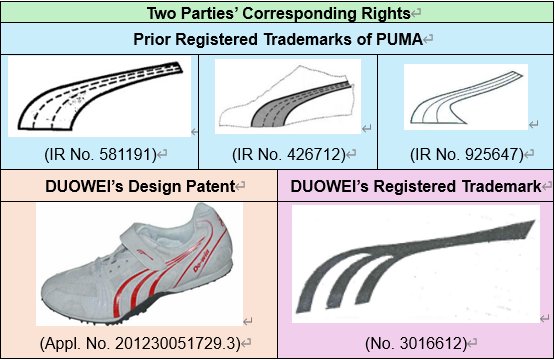
During the administrative procedures and the following first-instance court proceedings, the CNIPA and the Beijing IP Court both held that the disputed pattern primarily reflected the characteristics of DUOWEI's own trademark No. 3016612. Additionally, given the presence of the other word trademark "Do-win" on the product, confusion was unlikely, and thus the patent was maintained as valid. PUMA appealed to the SPC. After trial, the SPC finally ruled that the patent has conflicted with PUMA's prior legal trademark rights and should be declared invalid.
II. In-Depth Analysis of SPC's Logic
The reversal in this case not only concerns justice for the individual case but also clarifies the important legal application standards, such as "trademark use", "the boundaries of trademark rights", and "the determination of likelihood of confusion".
1. Recharacterization from "Decorative Pattern" to “Trademark Use”
In its ruling, the SPC noted that the disputed pattern was positioned prominently on the shoe's upper and occupied a relatively large area, consistent with common industrial practice of placing a trademark on such a position. The fact that DUOWEI had registered a logo similar to the disputed pattern as trademark further confirmed the intent for such use to be “trademark use.”
2. Ownership of a Trademark Does Not Justify Design Patent Registration
The disputed pattern was not identical to DUOWEI's registered trademark, and the alteration of the latter’s distinctive features made the disputed pattern more similar to PUMA's prior registered trademarks. Given the fame of PUMA's prior trademarks, the SPC held that DUOWEI's alteration has exceeded the legitimate scope of use of its own trademark. Instead, the alteration has constituted a disguised use of the distinctive features of PUMA's prior trademarks, likely to mislead the relevant public to associate the products exploiting the patent with those bearing PUMA's prior trademarks.
III. Practical Implications
This case is encouraging for authentic trademark holders. A "famous-brand freeloader's" own registered trademark can no longer serve as a "universal shield". Any attempt to circumvent infringement or free-ride on another party's famous prior trademark, whether through altered use of a trademark or by applying for a design patent, faces significant legal risks. China's judicial practice is increasingly leaning towards substantive judgment and the principle of good faith. Even with a certificate granted by the relevant authorities, if the actual method of use constitutes imitation of another party's famous trademark, it may still be deemed infringement. Right holders can cite this precedent in similar cases to actively safeguard their legitimate rights and interests.

